PET film cannot be calibrated by laser trimming like traditional ceramic or metal substrates, which places extremely stringent demands on printing accuracy and stability. This is a common industry challenge: poor consistency among multiple resistors and large fluctuations in batch yield.
Case Details
A technology company focused on blood glucose management has made a breakthrough in the development of continuous glucose monitoring (CGM) systems. The system provides continuous, comprehensive, and reliable 24‑hour glucose information and transmits the data to a mobile phone.
However, during the industrialization phase, the thick‑film printing process became a critical bottleneck. After extensive market research and comparison, the company learned about JYUTEC (full name: Changsha Jianyu Screen Printing Electromechanical Equipment Co., Ltd.) through TikTok, recognising its expertise in CGM printing and its track record of successful cases. They subsequently got in touch with JYUTEC.
1. Customer Requirements and Industry ChallengesAfter in‑depth communication, JYUTEC identified the client’s core requirement: to sequentially print two resistor layers and one encapsulation layer on a 200 × 170 mm PET film, with each layer containing 60 resistors. Because PET film cannot be laser‑trimmed for post‑calibration like traditional ceramic or metal substrates, the demands on printing precision and stability are extremely high. This is exactly the industry‑wide problem of poor resistor consistency and volatile batch yield.
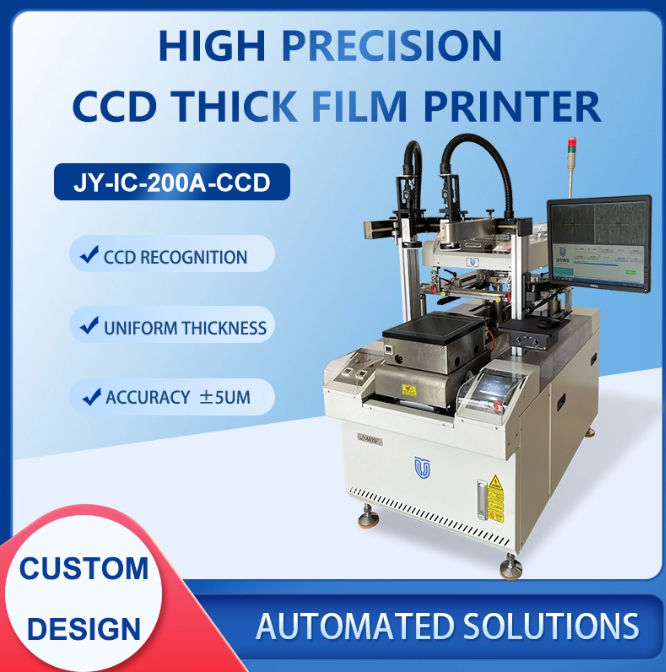
2. Rapid Response and Customised SolutionJYUTEC responded quickly and, to ensure the viability of the solution, arranged on‑site sample testing for the client. They used the high‑precision thick‑film printing press IC‑200A‑CCD, which has a maximum printing area of 200 × 200 mm and achieves high‑accuracy repeat printing through CCD automatic alignment. Addressing the technical details exposed during the on‑site trials, JYUTEC made customised improvements to the equipment platform, the print head, and the screen structure. After multiple rounds of process parameter optimisation, the final printed resistors showed stable resistance values, with deviations kept within the client’s specified standards.
High precision thick film screen printing machine IC-200A-CCD.
The maximum printing area is 200 * 200mm.
CCD automatic alignment printing can quickly align within 0.3 seconds, effectively reducing screen setting time and manual feeding errors.
The entire process is digitally positioned, and the buffering graphic printing accuracy is high.
3. Formal Cooperation and After‑Sales ServiceBased on the successful sample verification, both parties entered into a formal cooperation, and the client purchased four units of the IC‑200A‑CCD high‑precision thick‑film printing press at once. After delivery, JYUTEC sent process engineers to the client’s site for equipment commissioning, process debugging, and operator training. On the very first day of trial production, printing accuracy met all requirements, and every resistor passed inspection – achieving a 100% qualification rate.
In this collaboration, JYUTEC, with its professional equipment, customisation capabilities, and process optimisation expertise, provided the client with a full‑cycle printing solution – from sample testing to mass production – ensuring stable, high‑volume output of CGM products. This case clearly demonstrates JYUTEC’s professional strength and technological innovation in the field of precision thick‑film printing.